
Deep in the Andes: Journeying Into the Zipaquirá Salt Cathedral
After looking down at Bogotá from the peaks of Monserrate, the next leg of our journey took my family and me in the exact opposite direction: 600 feet straight down into the earth.
Located about an hour’s drive north of the capital lies the historic mining town of Zipaquirá. For centuries—dating all the way back to the indigenous Muisca civilization—these mountains have been mined for their rich rock salt reserves. But deep within the tunnels of an active mine sits something completely unexpected: a monumental, hand-carved underground church known as the Salt Cathedral of Zipaquirá.
Entering the Underworld
Stepping into the mouth of the mine, the outside world completely fades away. The air cools down instantly, carrying a heavy, distinct scent of minerals, and a long, dimly lit tunnel leads you deeper into the mountain.
What makes this place so fascinating is its history. Mining salt has always been incredibly hazardous work. In the 1930s, the miners themselves carved a small, humble sanctuary out of the salt walls, placing images of saints where they could pray for safety before starting their dangerous shifts. Decades later, that humble devotion evolved into a massive architectural masterpiece, completely carved from the halite rock.
As you walk the descending paths, you pass through a series of 14 dark caverns representing the Stations of the Cross. Each station is stark and abstract, featuring kneeling platforms and geometric crosses illuminated by soft, glowing LED lights that bounce off the raw, textured grey salt rock.
The Grand Cathedral Architecture
Just when the tunnels start to feel compact, the path opens up dramatically into a series of massive, cavernous naves that look like something straight out of a fantasy film.
The scale of the main sanctuary is jaw-dropping. Standing in the center are four massive, cylindrical columns carved directly out of the salt walls, symbolizing the four evangelists. Looking up into the darkness, you can see a soaring dome overhead, but the true focal point is a monumental, 50-foot cross carved directly into the rock face at the back of the altar. Illuminated from below, it casts a giant, dramatic shadow across the ceiling.
Every detail down here is a testament to incredible engineering and craftsmanship. Even famous works like Michelangelo's Creation of Adam and Pietá have been recreated by hand out of the salt.
The Mirror of Water & Chipping Our Own Salt (2017)
Before making the climb back up to daylight, we stopped by one of the mine’s most mesmerizing features: the water mirror.
This underground basin is filled with perfectly still brine water (highly saturated salt water). Because there isn't a single ripple on the surface, the water creates a flawless optical illusion. When you look down into it, the reflection of the illuminated salt walls and ceiling is so sharp that it feels like you are staring straight down into a bottomless cavern.
During our 2017 visit, the pathway near the mirror featured sleek, modern glass displays showcasing stunning Colombian emerald jewellery. But our favourite memory from this part of the mine was getting our hands dirty on the Ruta del Minero (The Miner's Route). We geared up with safety helmets and headlamps, stepped into the shoes of the real miners, and actually got to use a pickaxe to chip away a piece of raw rock salt from the walls. To this day, I still keep that little chunk of Colombian salt rock as one of my favourite travel souvenirs.
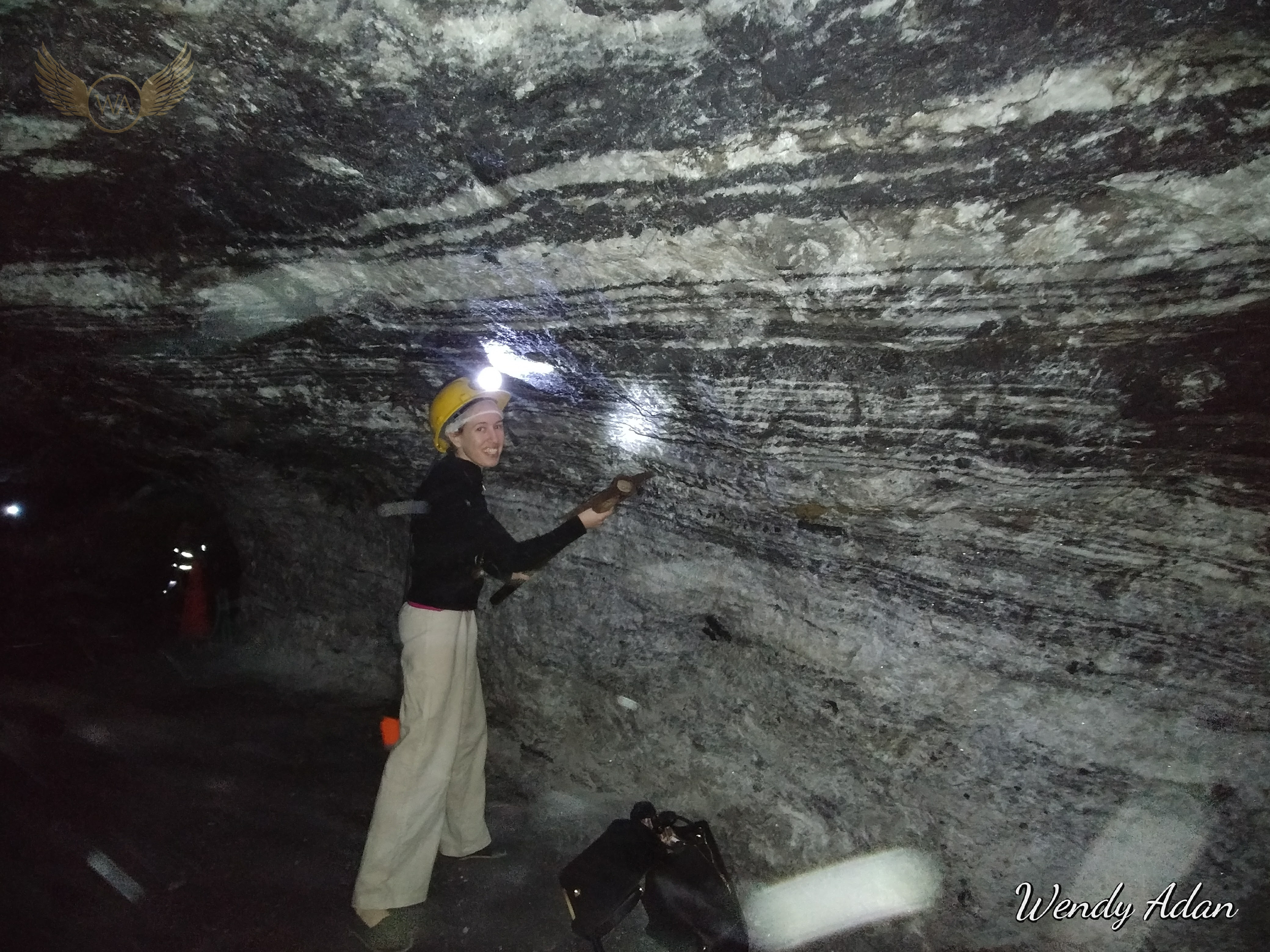
Testing out my mining skills inside the historic salt tunnels of Colombia.
How the Cathedral Has Grown Today
While those memories remain incredibly special, the Salt Cathedral has evolved into a massive, multi-experience underground complex. If you visit today, you’ll experience several major additions that weren't there during my trip:
3D Video Mapping (Added in 2023): Every 15 to 30 minutes, a state-of-the-art light show projects spectacular animations directly onto the rugged, soaring salt walls of the main nave.
The Monumental Sculpture Museum 180 (Added in 2023): A newly opened underground gallery space showcasing beautiful salt-carved and marble sculptures from dozens of international artists.
The Holy Door (Added in 2025): An incredibly detailed, hand-carved salt replica of the Holy Door from St. Peter's Basilica in the Vatican, located in the Chapel of the Virgin of Guasá.
The Last Supper (New for 2026): A breath-taking, fully immersive salt-carved replica of Leonardo da Vinci's The Last Supper, beautifully illuminated within the Chapel of the Virgin of Guasá.
Expanding Amenities: The commercial area near the exit has grown to include an underground café and food court, plus a vast market of local artisan crafts alongside the original high-end emerald jewelers.
Emerging back out into the bright Colombian sunshine, my parents and I felt a profound sense of awe. It’s one thing to see a beautiful church built under the open sky, but witnessing an entire sanctuary carved entirely by hand out of the dark, silent depths of a mountain is a memory we won't ever forget.
Planning Your Own Visit to Zipaquirá
If you are planning to add this incredible site to your own Colombia itinerary, it is incredibly easy to reach from Bogotá. While the inside of the cathedral must be explored on foot, you can easily reach the main park entrance by car, public transit (such as the Tren Turístico de la Sabana), or even by cycling the scenic, mountainous roads leading up to Zipaquirá if you want a true athletic adventure!